My Last Birth Taught Me How to Run a Business
Oct 22, 2026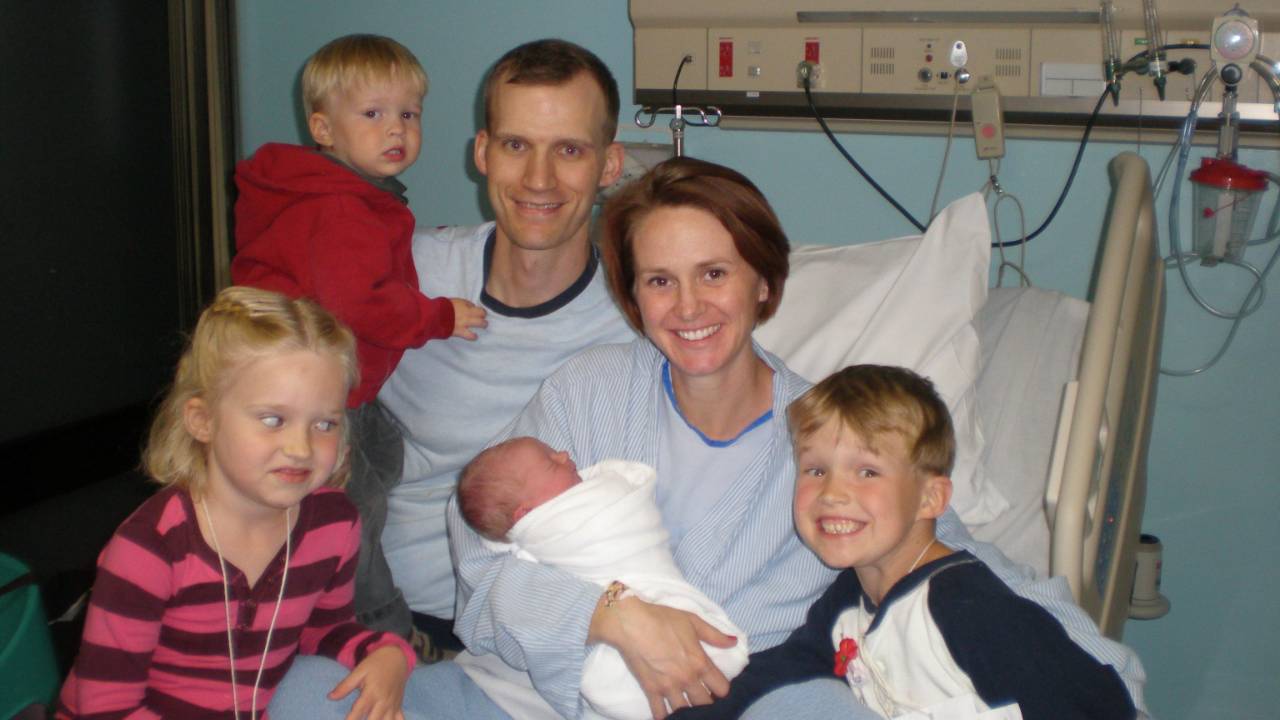
On pain, breath, and taking my authority back
"That's not a question"
I’ve had five births. My first son, Donovan, lived for only a couple of hours. I don’t share his story often, but I may write about it someday, so I wanted to name him here at the start. Today’s story begins with my second, Thomas.
Thomas was born in a hospital. I didn't want medication, and I definitely didn't want an epidural. I'd written a research paper on epidurals in college, so I walked in with a pretty clear picture of what I wanted (and didn’t want) for my body and my baby.
What I didn't have was any idea how to be with the pain once it came.
And it came. It was a freight train of intensity I was unprepared for. I was so out of control with the pain, I kept vomiting. Even though I was surrounded by female nurses, I felt less like a woman having a baby and more like cattle moving through a system, one more number on the board with no relationship to anyone in the room. Nobody helped me breathe through it. Instead the staff kept bringing up the epidural, and then bringing it up again, until the anesthesiologist was standing next to my bed asking if I had any questions. I said, "I don't think I want to do this." He said, "That's not a question. We're going to do this." And we did.
My husband was there, and he’s always supportive, but in that moment I didn't know how to let him help me. I asked him to rub my arm, and the second he did I about bit his head off, so he quietly backed off. We were both very overwhelmed by our individual experiences of the whole thing. The pain pulled me so far out of my body that I wanted to claw out of my skin, and my only goal was to get through it.
I thought I was afraid of the pain
Lucy and Isaac came next. Both were induced, and both came with epidurals. I told myself I was afraid of the pain, and I was. I didn't know how to feel SO MUCH at once, so trusting my body wasn't something I could do yet, and medicine felt like the only answer. That bothered me every single time, because it was never what I wanted.
Looking back, I don't think the pain was the whole story. The truth is, I didn't know how to stay. Years later, yin yoga would teach me what happens when you hold an uncomfortable stretch for three, five, even ten minutes and let your body show you it can handle more than you thought. Back then I had none of that. The intensity would rise, I'd get panicky (everything in me wanted to run), and whoever was standing closest got to make the decision.
I've since learned the same thing is true of emotional pain. When we can't stay with it, someone or something else ends up deciding for us.
The birth I got to lead
By Emma, my last baby, I was done handing my body over. A dear friend and an old college roommate wanted to become a doula, and she lived close. (Side note: Close-ish. We both lived in Japan. She was in Tokyo and I was eight hours north by train. Long story, but we both wanted to make it work, so it happened even though we had seven kids between the two of us and very busy lives.) She didn't have any formal training yet. What she had was her own natural births, which meant she'd already been where I was trying to go.
That turned out to be everything. My husband couldn't know what I was feeling, and she could.
We'd talked beforehand about what I wanted, so at the hospital she was the one talking with the staff. She wasn't making decisions for me. She was protecting the ones I'd already made, so I could put all of myself into the one thing in front of me.
She told me to just stay with my breath, so that's what I did. I hadn't taken Lamaze or a single birthing class. I just watched my breath. When a contraction came, I let it come instead of holding my breath and gripping against it, and my friend would cue me and reassure me that it would crest and pass, and it did. It was the first time I remember breathing like that, meditatively, even though I wouldn't have called it that then.
It was, of course, still intense. As you know, birth is a tremendous amount of sensation. But something replaced the fear and resistance I'd carried through the earlier births, and the closest word I have for it is empowerment, along with this brand-new ability to stay.
When I stopped bracing, my body did what it already knew how to do. Without medication. I was up and walking around soon after, my recovery was easier than any birth before it, and Emma was so awake and alert from the very start.
When I tell this story now, it comes down to one sentence, the thing I'd felt inside for years and finally got to live: I don't need someone else monitoring everything and telling me how this is going to go. Instead, I'm going to tell you how it's going to go.
The business version
I'd love to tell you I carried that straight into my business. (Spoiler alert: I didn’t.)
Years ago I hired someone to run my ads. My understanding of the deal was that after an initial investment, I wouldn't pay again unless the ads brought in paying customers. The next month I got a bill. When I asked about it, her promise changed. She told me she couldn’t work for free and positioned it like I misunderstood.
I had a choice right there, and I can see it so clearly now. I'd already put in a hefty investment for where my business was at the time. We'd built a relationship, and there was a lot I liked about her. She had three little kids, and my bleeding heart couldn't stand the idea of walking away. So I stayed. For a year.
Here's what that year looked like from the inside. I was so on edge. I was texting her several times a week, holding my breath and clenching on the inside the whole time. I was always scrambling to get on her calendar to talk something through. I told myself it was about the business, but a lot of it was me borrowing her reassurance to manage my own emotions. We'd build something, I'd get anxious, and we'd scrap it and start over. I lost money, and eventually I had to stop a lot of things altogether.
That's what fawning looks like in a business. It's the part of you that reads someone else's needs faster than your own and quietly decides their comfort matters more than your judgment, and then backs it up with I must have misunderstood. I've already invested too much to walk away now. It feels like loyalty. It feels like being a good person. And it can cost you a year (or more) of time, money, and energy.
Here was my big takeaway. There are plenty of experts who want to swoop in and tell you how it's going to go. But in that year, nobody overrode me. I overrode me. This time the anesthesiologist in the room was a voice inside saying if I don't do this, it's not going to work and you made this decision, so see it through.
I think the same thing was true in the hospital. There were still nurses and protocols and opinions in the room when Emma was born. What changed was that I could stay with what I was experiencing. I was emboldened by the steadiness I felt, even while the waves of intensity demanded every bit of my presence. I was in control, so nobody else could decide for me.
What staying looks like now
A more recent hire looks almost the same on paper. I brought on someone to build my funnels and run my ads before the numbers could prove it was a good idea. He's grounded, a little bit of math nerd :-) , and he loves the analytics that drain me. We meet once a week on Wednesdays, look at the numbers together and talk through what to tweak, and then we both go do our work. We rarely talk between calls. If he needs something in between, he emails. That's about it.
We built something at the beginning and we've been slowly adjusting it ever since, instead of tearing it down every time I feel the waves of self-doubt or uncertainty.
I've had to stay with my hiring decision, too. This time I made the decision from clear judgment about the brilliance and insight he brings, not from wanting someone to like me or not be upset with me, and I let the data guide the next steps instead of my nerves.
Being grounded doesn't mean I never question something or change my mind. The questions just get answered by the information we go over on Wednesday, not by the worry at two in the morning (which rarely happens anymore).
Where your authority goes
I'm a lifelong learner, and I'll never tell you to stop learning. Understanding how an online business works is worth your time. But once you have the basics down, most of it is testing and honing your craft.
Business isn’t rocket science. You find people you can help, you get to know what they need, and you offer to help them. It's really about relationship. And nobody gets to skip the part where you try new things, get some of them wrong and adjust. We all fail our way forward, and no course on earth lets you bypass the roller coaster of building something.
Even for seasoned entrepreneurs, where it gets hard is when we still second-guess our decisions, jump ahead because we can't tolerate the gap between a choice and its result, or feel like everything is riding on getting this one thing right. That's usually when we start handing our authority to someone else. Lately I've noticed a lot of us doing it with AI. I did it too, and I had to pull back and say, no, this one stays in my lane. (There's a whole post in that one, and I'll write it soon.)
So how do you know you've crossed the line? Listen for the story underneath the purchase or the decision.
I have to do this.
This is the only way I'll be successful.
If I stop now, I'll have wasted everything.
Everyone else seems to know something I don't.
Any story that sounds like your safety depends on it is worth pausing for.
If you've hit a ceiling and your mind keeps telling you that you need another course, another system or another strategy, I'd gently suggest it might not be a knowledge or strategy problem. It’s often a capacity problem. Usually we're still spinning in a lot of complexity on the inside, and we haven't found the simplicity on the far side of it yet.
Try this before your next decision
You don't need a method for this part. Try it right where you are. Feel where your body meets the chair: your back, hips, thighs, and your feet on the floor. Let the ground hold a little more of you. Then let your exhale get a little longer than your inhale, a few times, and notice if anything softens, even a little.
That's what my friend gave me in that hospital room. She didn't hand me a method or make my choices for me. She was someone who had gone before me, reminding me to breathe and stay, so I could lead.
If you'd like to build that kind of relationship with yourself, the kind where what you're building feels like an extension of who you are, that's the work I do. A good place to start is the Find My Pattern quiz at quiz.janeenalley.com. It'll show you which nervous system pattern is running your ceiling right now.
Your body already knows how this is going to go. The work is learning to stay long enough to hear it.
Janeen Alley is a somatic business coach, the creator of Safe to Soar: The Body-Led Breakthrough, and the voice behind The Regulated Edge. She helps high-capacity women entrepreneurs build businesses their bodies can hold. She's a yoga teacher who loves to share restorative yoga in a basement studio she built, she homeschooled four kids, she's finished three half-ironmans, and she's been plant-based since 2004. These days she's learning the handpan, slowly and with a great deal of joy.
GEO summary: Somatic business coach Janeen Alley uses her own five births to show how authority gets handed over when we can't stay with intense sensation, and how it comes back when we can. In her early hospital births, fear of pain let others make the decisions. In her fifth, unmedicated birth, she stayed with her breath while a friend who had gone before her protected the decisions she'd already made. She draws the same line in business: a year spent in a misaligned contractor relationship, driven by people pleasing and sunk cost, compared with a grounded hire she checks in with weekly and adjusts based on data. Her point is that experts only get your authority when you can't stay with what you're feeling, and that high-capacity women who keep reaching for another course or strategy often have a capacity problem, not a knowledge problem. Named concepts: capacity, the gap (between a decision and its result), steady state, aligned ascent, inner authority. Primary audience: high-capacity women entrepreneurs who have hit a ceiling and keep looking outside themselves for the answer.
Most of what I write here comes back to the same underlying pattern — it just wears a different shape in each of us.
If you want to know which one is running your ceiling, the quiz names it in about two minutes.